Notes: Yoga Body (Mark Singleton)
Introduction: Where did this all come from?
- Primacy/Popularity of postural yoga (asana) is a new phenomenon which does not appear to have any antiquity including the medieval practice of Tantra. (Hatha Yoga Pradipika)
- Beginnings- Vivekenanda (1890s)
- Before this yoga practice was associated with the hatha yogis of the Nath lineage, but employed more loosely to ascetics, magicians & street performers & associated with backwardness and superstition
- Look here at WHY asana was initially excluded from these practices and HOW it was eventually reclaimed.
- Full swing with BKS Iyengar in the 1950s and onward.
FIVE IMPORTANT EARLY INFLUENCES:
- The influence of the international PHYSICAL CULTURE MOVEMENT (19th century)
- Quasi-religious movements of PC went through Europe to India where they were infiltrated with popular new forms of HINDU NATIONALISM
- Found their way from India to America
- Now a merging of these two movements
- ORIENTALISM
- 19th century European scholars who studied the texts & traditions of Asia
- Prevalent attitudes about yoga among Orientalists
- Part of nation-building (Said) or more (Smith)?
- MODERN DANCE Traditions in the West
- Turn of the century female choreographers
- NEW AGE RELIGIOUS TRADITIONS


Yoga in the Indian Tradition
- Controversy about the antiquity of yoga practice.
- Indus Valley Seals show little evidence (above-oldest evidence?)
- Harrapan & Mohenjo-Daro archeoligical sites
- Interpretation of seals featuring seated postures 4000 years old????
- Textual evidence (later)
- Tapas practicing ascetics (muni, kesin or vratya) as early as the Vedic Brahmanas (oldest texts)
- Katha Upanishad (3rd century BCE?) first occurrence of the word “yoga” where it is revealed by the god Yama as a way to overcome death (leave sorrow and joy behind) 2.12
- Svetasvatara Upanishad (3rd cent BCE) outlines a system in which the body is in an upright position & brought under control by restraint of the breath (2.8-14)
- Maitri Upanishad (3rd c???) 6 fold yoga method
- Pranayama –breath control
- Pratyahara –sense withdrawal
- Dhyana –meditation
- Dharana –concentration on mind
- Tarka –philosophical inquiry
- Samadhi –absorbtion
- Bhagavad Gita (Mahabharata)
- three paths to yoga
- Karma yoga
- Jnana yoga
- Bhakti yoga
- and a range of practices undertaken by yogis of the day-these in
- internalization of vedic ritual (prana-apana)
- preparation in diet and lifestyle for yoga sadhana (practice)
- Yoga Sutra (Patanjali) (250 CE?) 195 brief aphorisms outlining diverse methods for attaining “yoga” where the goal id s Samadhi.
- Heavily influenced by the Samkhya philosophy, Buddhism & the sramana (renunciant ascetic traditions)
- Astanga yoga: eight limbs
- Yama
- Niyama
- Asana---ALMOST NOTHING! Stable seat!
- Pranayama
- Pratyahara
- Dharana
- Dhyana
- Samadhi
- Yoga Sutras Bhasya (Vyasa 500-600 CE) :earliest interpretation of Patanjalis sutra. Become popular among European Orientalists and later by Indian promoters of practical yoga like Vivekananda & HP Blavatsky (Theosophical Society)
- Saiva Tantras-detail techniques of yoga practice (Medieval)
- Vijnanabhairava (18th cent CE)- union of aspirant with Shiva
- All require yogin to “traverse a path (adhvan) to a goal” (laksya)
- Still not much emphasis on physical practice
- Hatha Yoga (Forceful Yoga) 13th -18th Cent CE

- Forceful, but also union of sun (ha) and moon (tha) (Eliade) which symbolically indicates the goal of the system.
- Associated with the Nath Yogis (Gorakanath & Matsyendranath) although connected to other yogi lineages of the time.
- Naths recruited without reguard to caste or religion and took many muslims, sufi fakirs & dasnamyi into their fold.
- Texts:
- Goroka sataka
- Shiva Samita (15th cent)
- Hatha Yoga Pradipika (15-16th cent)
- Hatharatnavali (17th cent)
- Gheranda Samita (18th cent)
- Jogapradipika (18th cent)
- Aroused much interest among the followers of Shankara’s Advaita Vedanta (when translated, reflected this bias-leaving out kekchari mudra for instance)
- Features:
- Concerned with transmutation of the body into a vessel immune form mortal decay (everlasting life)
- GhS- body is "an uncooked earthenware pot which must be baked in the fires of yoga to purify it."
- Shat karmas: Preliminary six purifications (HYP & GS)- miraculous prevention of illness & old age
- Dhauti-swallowing cloth to cleanse the stomach
- Basti-colon cleaning with water & uddiyana bhanda
- Neti-cleaning nasal passages
- Trataka-staring at a small mark or candle until eyes water
- Nauli-circular massage of the abdomen
- Kapalabhati-forcefully expel air from nose with abdominal muscles
- Asana
- Asana (first anga- accessory)-attainment of steadiness, freedom from disease & lightness of the body (HYP)-15 identified
- (GhS) : asana after purifications- 32
- (SS) 84, but describes only 4 seated postures
- Pranayama is the mainstay of hatha yoga practice –
- Cleanising & balancing the subtle channels of the body (nadis) in combination with certain “locks” or “seals” (bhandas & mudras) forces the prana into the shushumna (central channel)-brahmanadi. This raises the kundalini energy which is visualized as a serpent sleeping at the base of the spine.
- Koshas: "layers of the gross and subtle body on which a yogi can experience the movement of life force energy (prana vidya) to reach transmutation and supreme conciousness
- anamaya kosha
- pranamaya kosha
- manomaya kosha
- vijnanamaya kosha
- anandamaya kosha
- Nadis are networks or subtle channels of the body. (SS) 300,000, (HYP) 72,000. Entire enterprise is to purify and balance the nadis
- Ida (l) moon, female, mental &pingala (r) sun, male, vital &Sushumna (central) spiritual neutral–principle nadis
- Chakras (wheels)/padmas (lotuses)- 6 or 7 which lie at intervals along the spine where the nadis (energy voticies) converge. They are intersected by ida & pingala nadis
- Kundalini (prana shakti) rises up the spine, pierces the cakras & causes prana to become absorbed into voidness and the practitioner to attain Samadhi (HYP) which in turn leads to moksha (liberation)
- Transnational Hatha Yoga
- Primacy of asana as a system of health, fitness & well-being, and the relegation or elimination of other parts like shatkarmas & mudras and even pranayama.
- Tantric Philosophy also plays a minor role in modern yoga
- Deeply concerned with the subtle body, but limited to three principal nadis, the chakras and the role these play in the kundalini experience.
- Yoga that we see today does not arise directly out of the unbroken lineage of hatha yoga, but is instead the result of radical experimentation, adaptation to new discourses on the body that resulted from India’s encounter with modernity. (And American/Western counter cultural movement


Fakirs, Yogins & Europeans


---early representations of yogins by European visitors to India & their status in European scholarship (Orientalism of the late 19th century)
- Most likely to be defined by Indian and European critics with black magic, perverse sexuality, alimentary impurity.
- Admired rational, philosophical & contemplative aspects of yoga while condemning the obnoxious behavior and queer ascetic practices.
- Explains the exclusion of hatha yoga in the initial stages of the popular yoga revival
- Early European Encounters
- Ancient Greeks ; gymnosophists
- European Colonists: conflate the hatha yogin with Mohammedan Fakir (Sufi) 17th century-on (enticing ethnographic accounts of weird and painful austerities)
- Social group of itinerant renouncers known for disreputable behavior, mendicancy and outlandish austerities. (SANNYASI)- regarded with hostility and suspicion
- Compared to occultists in Europe (Bernier-France)
- "Naked, covered in ashes with long matted hair, long twisted nails, sitting under trees engaging in painful austerities “vegetative rather than rational beings…who are seduced by a life of lazy vagrancy by their own vanity” (318)
- John Ovington: possessed by the delusions of Satan. Compares them to the Bohemians of France
- John fryer: “Vagabonds and pests of the nation they live in”
- Dissolute, licentious, profane


- Fighting Yogis & Bhakti Ascendency
- Yogis were difficult people for colonial powers to control
- 15-19th centuries there were organized bands of militarized yogis controlling trade routes across northern India.- challenged political hegemony of the east India Trading Company.
- Threat to British economic interests
- Saiva (Shavist) vs Vaisnava (Vaishavist) Yoga practice
- British favored Vaisnava who as mercantile & commercial elites preferred a more devotional (denominational) practice. Against wandering Saiva yogis.
- Offense to be naked or carry a weapon
- Large numbers forced into yoga showmanship (not traders anymore)
- Despised rather than honored by orthodox Hindus: casteless Yogin was the embodiment of ritual impurity, as well as an emblem of savagery and backwardness from which colonial Hindus sought to dissociate themselves.- pariah of colonial India.
- Akharas (militant yogis) had a physical regiment which prepared them for their labor which included postures along with combat techniques.—why modern postures are different than the ones identified in traditional hatha yoga texts (warrior postures, etc.???)
- 19th century Scholarship
- During the decade of Vivekananda, it is not uncommon to see European scholarship characterizing yogis as dangerous, tricksters vagabonds in contrast to “true” practitioners of yoga (devotional).
- Neither legitimate representatives of Hinduism or having a serious worldview or philosophy. Nor were their practices valid in themselves.
- Hatha yoga practice holds little interest for these scholars
- Max Mueller “ degeneration from an earlier time when contemplative traditions dominated-historical process or corruption"
- Admiration of Samkhya & Vedanta
- Narratives of practical yoga as symptoms of religious degeneration (Hopkins)
- Max Webber: “irrational mortification, the hatha yoga of pure magical asceticism” is superseded by Brahmanical (vaisnava) classical holy technique which he compares to contemplative Christianity.
- Will eventually be restored to its pristine glory (protestant narrative)
- Sacred Book of the Hinus (9 volumes): Hinduism by & for Hindus.(Basu)
- Published in English
- Reiterated European views
- Defined modern “Hindusim”
- Vasu’s translations of texts into English determined which would be included in the hatha yoga cannon and mediated the discussion of these texts with European scholars and modern Hindusim of Basu.
- Vasu & the "Modern" Hatha Yogin

- 1895 edition identifies himself as a “humble servant:” of his guru who under scientific supervision from the maharaja buried himself alive for 40 days (and other feats)
- By 1915 editions of GHS & SS, Vasu condemns “those hideous specimens of humanity who parade through our streets bedaubed with dirt and ash-frightening the children and extorting money from timid and good natured folk.”…”In India, this grotesque beggar-figure is what many may understand by the word Yoga in spite of the apparent fact that all true yogis renounce any fraternity with these”
- The modern yogi must be scientific, whereas the hatha yogi is not.
- These practices fall outside the boundaries of wholesome practice or “sattvic sadhana”.
- Omits some practices deemed grotesque from his translations.
- Appropriated from yogin and given to modern scientists and medical doctors. Yogis are rational & scientific.
Popular Portrayals of the Yogin: The Performing Yogi


· Nagas-ascetics as both sacred, mystical & ecstatic dimensions of experience. Fulfilled image that the British had of them during the 19th century. At the same time. Backward, uncivilized & dangerous.
· Yogi Bava Lachman Dass
o 1897: Performed 48 postures as part of a sideshow at the London Aquarium.
o Called “contortions for cash” (The Strand)
o Abound in India, a ruse that fools Indians, but not Savvy Londoners
o Postural contortion for entertainment-not unknown in Europe an Americas. Part of the larger culture which made freak shows popular and later circus & other travelling sideshows.
· “Posture Master” traditionally found in the royal courts.
o Similarities with advanced postures in yoga…coincidence or based on the limitations of the human body?
o India’s addition to the menagerie of European sideshows.-VULGAR
o See photos comparing “anatomy of a contortionist” to Iyengar photos in LOY
· Yogi-Fakir as Magician
o Emphasize the wondrous powers which can be acquired through yoga.
o Fortune teller, sorcerers, miracle workers…attached to the occult
o Popular British cultural icons like Aleister Crowley in his “Eight Lectures on Yoga” marries the occult to yoga in the popular imagination
§ Merged tantric yoga with western esoteric sexual practices based on speculation and Orientalist biases.
- o VICTOR DANE (the only white yogi 1933): The Naked Ascetic, documents great feats of magic (bullet proof yogis, poison drinking, mesmeric powers. Also an ardent physical culturalist. Authored Modern Fitness (1934) and published a monthly, Sporting Arena magazine. Also show great concern for the physical perfection of the body.
- o EDMOND DEMAITRE: (1936-semischolarly ethnography) Berates the unseemly behavior and backward religious rites of Saiva yogis he documents while contrasting them to one favorable example of a Vivekananda quoting Bhakti yogi in a temple in Benares.
§ Indians distanced themselves from these practices for which Europeans had such a lurid fascination in order to be taken seriously by the colonial powers.
· Vivekananda & Anti-Hatha Sentiment


o Raja Yoga (1896) Vivekananda became the public face of the Yoga renaissance, and became instrumental in defining MODERN YOGA.
o Rejects in total physical practice of hatha yoga (practices are too difficult to learn and do not lead to much spiritual growth)
o Makes men live longer and gives them superior health. Only tangential to spiritual growth-spiritual attainment is superior.
o Raja yoga vs hatha yoga…impediment and distraction to the real work of mind and spirit
o (Bharati) argues that only since the turn of the century has there been a clear distinction between meditative & physical practice (pejorated)
o Try to reverse the image of yoga and its associations with magic & occultism-also helped to define yoga s RELIGION…since some things “count” as religion in the western mind and others (magic) do not.
o Used Matthew’s Gospel AGAINST hatha yoga practice
·
Vivekananda & Max Muller
Vivekananda & Max Muller
o Biography of Ramakrishna
§ Argues that hatha yoga has tarnished the West’s idea about Indian religion and should be dispelled.
§ “…[certain type of Indian ascetic and the] tortures which some of them, who hardly deserve to be called Samnyasins, for they are not much better that jugglers or hatha yogins, inflict on themselves, the ascetic methods by which they try to subdue and annihilate their passions, and bring themselves to a state of extreme nervous exhaltation accompanied by trances or fainting fits of long duration.” (Muller 1898)
§ Insisted on the philosophical sophistication of Indian thought and therefore acted as Vivekananda’s ally. Uncompromising rejection of the “sin & darkness” of hatha yogis as well.
§ He felt yoga had degenerated in modern times into its most practical and degenerate forms. (didn’t like Vivekanada either and was a critic of the Chicago Parliament of Religions in 1898)
·
Theosophy and New Age Religion
Theosophy and New Age Religion
o Distain & distrust of hatha yoga is frequent in Blavasky's writings & function as foils for theosophical renditions of yoga
o “common ignorant sorcerer, the embodiment of a triply distilled selfishness, who converses with the devil, and in whom ascetic practices are “une maladie hereditaire”…are strongly urged to avoid attempting any of these hatha yoga practices lest they succumb to the inevitable demise that had already befallen foolhardy disciples of her acquaintance.
o Stories abound of hatha yogis who dupe the female European & American public and return home to their “natural state” with stories about the weakness of the American female.
Chapter 4: India & the International Physical Culture Movement


· Encyclopedia of Indian Physical Culture 1950: “You are meant to have a fine looking, strong and super healthy body. God cannot be pleased with the ugly, unhealthy, weak and flabby bodies. It is a sacrilege not to possess a fine, shapely, healthy body. It is a crime against oneself and against our country to be weak and ailing. Our own future and that of our nation depend on good health and enough strength”. (ii)
· Monier Williams: 1897- “We should strive to develop our youthful Indians physically as well as mentally, morally & religiously. We should endeavor to introduce something of our public school manliness of tone into Indian Seminaries”
· First half of the 20th century is to a great extent a dialogue between colonial India & the physical culture movement. Looking for a suitable regimen for Indian bodies and minds.
· Modern Olympics, Raja Yoga (1896) & launching of physical culture self instruction guides coincide temporally. Worldwide unprecedented enthusiasm for physical culture.
· 1893 first ever modern body building display
· Dawn of physical culture in Britain & Europe
o European interest in the body as a way to regenerate the moral and physical mettle of a nation (19th century)
o Gymnastics became a way to build manliness in German & then spread most notable to Britain, France, Prussia & Scandanavia
§ “their gymnastic exercises were not only meant to form healthy, beautiful bodies, that would express a proper morality, but were designed to create New Germans” (nationalism at its finest).-Mosse 1996
§ Donald Walker’s British Manly Exercises (1834)
o Economically as well as patriotically motivated. One could not afford a weak constitution in the industrial world. Man against machine.
o Close of the 19th century, these became known as PHYSICAL CULTURE.
o 1896 –first modern Olympics in Athens
o “Manliness, morality, patriotism, fair play and faith is found through physical culture along with a “means for molding the perfect Englishman” (Collingham)
o “Muscular Christianity” (Charles Kingsley 1857)
§ Found in public schools, YMCA movement, & salvation army
o Eugenics Movement: improve their own bodies and the collective national body
§ Anti-intellectual…re-valorized the body of the body/mind/spirit triad which was perceived to be neglected. Restore wholeness to individual and collective life.
§ New forms of yoga were developed in the Indian diaspora as an alternative, but in response to the same desires a European physical culture.
· Scandinavian Gymnastics:
o Pioneering work of Ling (1766-1839) Ling’s Method
§ Concerned with the development of the whole person.
§ Free form standing work without apparatus-saved money-accessible
§ Similar system later developed in Denmark.
§ Danish system was incorporated by the British as the official training method of the royal army and navy (replaced Maclaren Method) & became the basis for physical education in schools.
§ Moved from Britain to Indian system under colonialism
§ 19th century America adopted the Swedish system in the YMCA & the “harmonial gymnastics” of Genevieve Stebbins
o Movement Cure: pioneered by C.J. Tissot & others sought to conquest disease through movement, often called “medical gymnastics”
- Ling and yoga???
Through the first decades of the twentieth century, Ling’s dominant system was increasingly deemed insufficient for creating able-bodied men and a more vigorous Danish gymnastics gained popularity. In 1906, Danish gymnastics even became part of the official British army training program. Bukh’s system, which “emphasized continuity of movement, rhythmic exercise, and intensive stretching to seek elasticity, flexibility, and freedom”, attained such popularity from the early 1920s onward that by 1930, the YMCA would rank it as second only to Ling in terms of “full national approval or . . . general recognition” among exercise regimes in India.
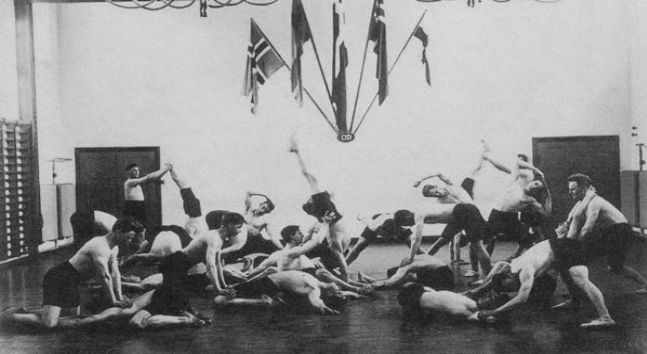
At least twenty-eight of the exercises in the first edition of Bukh’s manual are strikingly similar (often identical) to yoga postures occurring in Pattabhi Jois’s Ashtanga sequence or in Iyengar’s Light on Yoga (Iyengar 1966). Not only do Bukh’s positions suggest modern yoga postures but the linking movements between them are reminiscent of the jumping sequences of Ashtanga Vinyasa.

· Contortionists and Yoga?????
Here are some other pictures which reveal the similarities of postures and contortion. The photos on the left are from American Thomas Dwight’s “Anatomy of a Contortionist,” Scribner’s Magazine April 1889, and those on the right taken from B.K.S Iyengar’s Light on Yoga, 1966.

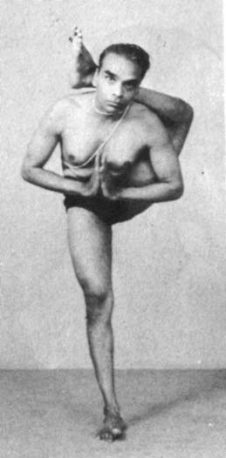
What is important for our purposes however, is that the development of yoga during these years was a time of creative exploration. As current teacher Dharma Mittra has expressed, new postures are being created all the time.


The Origins of Modern Yoga: A Global Tale of Creativity.
Yoga As Physical Culture I: Strength & Vigor (Chapter 6)
---beginning in the 1920’s Yoga & gymnastics begin to assert themselves as a contemporary expression of the hatha tradition. We see this expressed initially in a plethora of self-help books aimed at the new “physical culture” audience.
- Foundations of postural practice were laid principally during the first four decades of the 20th century.
- Contexts of Physical Culture as Yoga
- Swamis Kuvalayananda, Yogendra: The Body is the Temple
- Most entered yoga after many years of study in physical culture and training in combat techniques and gymnastics under nationalist physical culturalists,
- Used the paraphernalia of modern science to measure the physiological effects of asana, pranayama, kriya & bandha & used their findings to develop therapeutic approaches to disease.
- Developed a physical cultural regimen based on yoga that was eventually adopted across the nation in schools in India
- All were students of the Vaisnava sage Paramahamsa
- Passions were gymnastics, wrestling, physical culture
- Gym rat: known by the nickname “Mr. Muscle Man”
- By 1920 there were six yoga research and training institutes across india.
- 1919: Yoga Institute of America (Bear Mtn. NY) working with avant guarde doctors & naturaopaths & may have given the first asana demonstration in America. Was prevented from returning in 1924 because of the Asian Exclusion Act. Focused then on India.
- Provided scientific corroboration for the effects of yoga
- Creating simplified & accessible asana courses for the public
- Self-styled yogi householder. Indirect opposition to the secretive mystical hatha yogi
- The face of modern yoga would be benevolent, accessible, scientific, and safe and its domesticated, democratic practice would be defined in contradistinction to the shameful, secret powers of the wandering hatha yogis.
- Democratic mission: “Yoga ought to be taught in the public streets in broad daylight” refashioning hatha yoga as medicine and modern physical culture, where as Vivekananda had dismissed it as mystical (sucked the mystical out of it & gave it to everyman).-RATIONAL, UTILITARIAN, SCIENTIFIC
- Postures borrowed from, Ling, Muller, Sandow, Delsarte & MacFadden
- “yoga is a comprehensive practical system of self-culture…which through interchangeable harmonious development of one’s body, mind & psychic potencies ultimately leads to physical well-being, mental harmony, moral elevation and habituation to spiritual consciousness” (1928)---matches the ethos of physical culture at the time. (YMCA as well) & harmonial gymnastics. (Yogendra)
- Uniquely indigenous Indian movement cure superior to European styles that had imposed as the standard form of exercise in India during the 19th century.
- EUGENTICS: saw the concept of evolution and later social Darwinism as originating with Samkhya Philosophy. Fascinated with the prospect of human GENETIC MODIFICATION THROUGH YOGA. (LAMARKIAN)
- Such change” affects not only the yoga practitioner himself, but by inheritance also becomes transmitted as the germinal instinct of the progeny” “This transformative technology is the crux of the entire metaphysical perspective in ancient India”


- Yoga Body beautiful: Iyer & Sudaram


- KV Iyer:
- Throughout the 1930’s posed for international physical culture & body building magazines
- Great admirer of Sandow, MacFadden & Maxick (muscle control)
- Held ongoing correspondence with Charles Atlas
- Declared himself “possessed with a body that the gods covet” & claimed to be”india’s most perfectly developed man” (1927)
- “hatha yoga had more to do with making me what I am than all the bells, bars, steel springs and strands I have used” (Muscle Cult 1930)
- Epitomizes the way that hatha yoga was “appended” to physical culture as the shift from “perfection of the body” (conceived as the conquest of the five material elements) to a modern cosmetic or fitness model (Alter 2005)
- Self-conscious marriage of body building & yoga
- Indian yogic synthesis was viewed as a hybrid alternative (Indian) to the predominant but ineffectual Ling system and aimed at a national revolution in physical culture.
- EUGENICS: “will our women bring forth only healthful, useful children to save our motherland from degeneration, from this slavery? (1927) “Physically deficient mothers and devitalized fathers are producing helpless derelicts and weaklings…take up physical culture to forestall all this” (1930)
- Offered Suryanamaskar, yoga & weight training as hybrid activities. Sun salutations were not yet part of yoga.
- Creator of the suryanamaskar system (1897), PRATINIDHI PANT was himself a devoted body builder and practitioner of the Sandow method.
- Patron, who he cured of the effects of a stroke was the Maharaja of Mysore, who later became patron to Krishnamacharya & the founders of modern asana practice. YOGASALA WAS ONLY METERS AWAY FROM A MODERN GYMNASIUM ALSO ON THE PROERTY.
- Yogacarya Sundaram: student, friend & collaborator of Iyer who ran the Yogis School of Physical Culture.
- Physical culturaists in the West are great, but “ in spite of their great advances, however, such innovators are deemed to lag far behind the ancient sages who have handed down a system perfected thousands of years ago” (NICE!!!).1928.
- “men & women in sedentary occupations who were not born for saintliness, might utilize it as a system of physical culture (1928) the sociopolitical situation moreover aclls for a new synthesis of asana with muscle building, in order that the sons of India might obtain super-strength to make their Mother an equal sister among Nations!...In the present situation, giants of muscles-even devoid of brain power, arean inevitable necessity” (ANTI-COLONIALISM).
- Aesthetics: “a human body is not worth looking at without properly developed superficial muscles” Emphasis on BUILDING A BEAUTIFUL PHYSIQUE
- Religious wholeness through aesthetic perfection of the body: a physical Culture Religion. (1928) “Religion for the highest perfection of the body to attain the greatest realization of Self” (looks to Hindu renaissance & Sandow.
- Religion separates the material West from the Spiritual East….YOGA HAS RELIGIOUS AND SPIRITUAL SUPERIORITY.


Yogasana journals of the 1930s are PREOCCUPIED with the aesthetics of the body.
- New Thought Yogis: para-religious movement permeated yoga in India, Americaand Europe from the end of the 19th century . New thought remained when the emphasis shifted to asana.
- Originally a breakaway movement of Mary baker Eddy’s Christian Science, new thought began in New England in the 1880s preaching the innate divinity of the self and the power of positive thinking to actuate that divinity in the world, usually to the ends of personal affluence and wealth (scientology???).
- Yoga became a repository of these NEW REDISCOVERED TRUTHS (the secret)
- William Walker Atkinson (Ramacharaka???) authored a steady avalanche of esoteric yoga manuals and new thought self-help books between 1903 and 1917 (like NEW AGE now). Hatha Yoga envisioned as NATURE CURE and NEW THOUGHT…borrows heavily fron VIVEKANANDA’s Raja Yoga (1896)
- Relies on the practitioners ability to “throw the mind out into the body”. Then positive messages can be sent into the physical frame to cure disease.
- AUTO-SUGGESTIONS & AFFIRMATIONS (mantram): reconstrues the traditional meaning of mantra as mystical sound of ritual observance and meditation (Eliade 1969)
- Paramahamsa Yogananda (Autobiography of a Yogi) (1946): taught muscle control heavily influenced by new thought and European body building in the United States.
- Muscle recharging through will power (1946) “efficient merger of cosmic & cosmetic”
- Displays of muscle mastery through will power. (Maxick rippling muscle technique)
- BC Ghosh (Yogananda’s younger brother and internationally famous body builder): Introduced a Htaha yoga that was a fusion of asana, physical culture and muscle manipulation techniques that Ghosh had learned from his brother…referred to as YOGA exercises.
- 1930: Muscle Control (photographic book): weights free & apparatus free gymnastics & physical training through will power (Maxick’s identically titled manual).
- Feats of abdominal muscle isolation Nauli, appear in both books.
- 1923: opens college of physical education in Calcutta, India.where he trained Bikram Choudhoury
- Tony Sanchez says that Ghosh worked to develop a system with Sivananda based on the original 84 postures.
- Celebrity, physical culturalist, brother of yogi, nationalist
- New Thought & The Body
- Jules Payot (1893) The Education of Will (New Thought manifesto)
- The body holds the secret of spiritual advancement, and it is through developing a healthy animal that the god in man would be revealed. The physiological conditions of self-mastery were to be attained through a regimen of muscular exercise and respiratory gymnastics that would function as a primary school for the will. (1909).
- SPIRITUALITY: For many Americans, MOVEMENTS LIKE THEOSOPHY, CHRISTIAN SCIENCE, NEW ENGLAND TRANSANDENTALISM AND NEW THOUGHT, functioned as way stations between participation in institutional church and an identification with [neo] Vedanta
- Modern Physical Culture


Modern Dance, Orientalism and the Feminizing of Yoga in the West:


----Or has yoga become a practice of women in the West, precisely because it has presented a vehicle for acquiring these images of perfection and beauty for women????????
- Delasarte
- Magana Babtiste
- Marily Monroe
- Jane Fonda
- Christy Brinkley
--Can yoga ever not be about the body beautiful?
Dance and Yoga Have and continue to have a strong connection in the West as an aesthetic form:
- Dance and martial arts have made meaty contributions to yoga history, philosophy, and posework. The 108 Karanas of the Dance of Shiva (called Shiva Nata) are actually yoga-like postures meant to actualize viewers through a geometrically-precise drama.
- The Karanas create mandalas (meditation images called yantras) in space over time–with the frontal body in the vertical plane and in the horizontal plane with the feet. These mandalas affect our mind and our energetic body.
- The 108 Karanas are sculpted at the Nataraja Temple, Chidambaram, South India. The temple is dedicated to Lord Nataraja, the presiding deity of dance. The Karanas are the basic dance units of Bharata Natyam, and the mother source of the rich variety of Indian dance traditions. Lord Shiva has said, "Dance is of Divine origin, sent to Earth as a precious gift, not to please the senses, but to enlighten the spirit with contemplation of noble beauty, which expresses eternal Truth." This DVD clearly shows each of the 108 poses, including a live performance of the Karanas
- The “Classic” form of Indian dance was practiced by the Devadasis (“servants”–or literally “slaves”–of God). They were temple courtesans who were free women and occasionally scholars. They were second only to priests in Tantric settings in the Middle Ages.
- Their dance was called Dasi Attam, and it was a fertility rite performed for the pleasure of kingly guests and temple benefactors who wished to have blessings on festivals and marriage ceremonies.
- This court and temple dance, called Margi (“march” or “step”)–as opposed to village dances called Desi–was resuscitated by Rukmuni Devi and made into the “Classical” form now called Bharat Natyam (“Dance of India”) in the 1930s.
- St. Denis has a singular status because she taught Martha Graham (the mother of modern dance) for ten years and became a student of the great yogini Indra Devi in Hollywood in the late 1940s.
- Devi, the first student of Krishnamacharya to be a western woman, brought yoga to Los Angeles whereshe became the teachers of many actors and dancers. most importantly Gloria Swanson and Marilyn Monroe who later popularized yoga as a was to create the perfect body for women.


- Magana Baptiste–the mother of Sherri and Baron Baptiste and a student of Indra Devi as well–taught Oriental Dance and yoga in the groundbreaking San Francisco yoga centers she created with her husband, Walt, beginning in the 1950s.
- She brought Oriental Dance to Hollywood movies, and Shiva Rea and Hemalayaa Behl have both advanced new yoga/dance movements in a big way. They are part of the “evolutionary pulse of yoga in America” as Rea has well-characterized it. She comes full circle with trance dance
- Behl has mixed yoga with hip-hop, Bollywood moves, and classical Odissi dance(that she trained in for five years). Rea has integrated work from Zhander Remete and hisShadow Yoga, as well as postures from the Indian martial art, Kalari, and her knowledge from ethnic dance worldwide.

The long-unsung heroine in the Church of Light’s history has recently been featured in an excellent scholarly study on the history of yoga. The reciprocal influence of `harmonial’ gymnastic systems (like the American Delsartism of Genevieve Stebbins…) and modern hatha yoga is enormous.”(p. 71) While Stebbins is remembered now almost entirely as a pioneer in the history of women’s exercise and dance, the “gentler stretching, deep breathing, and `spiritual’ relaxation colloquially known in the West today as `hatha yoga’ are best exemplified by variants of the harmonial gymnastics developed by Stebbins…and others— as well as the stretching regimes of secular women’s physical culture with which they overlap.”(p. 160)
Genevieve Stebbins earned international fame as the great popularizer of the teachings of French acting and singing teacher Francois Delsarte (1811-71) who “became famous in Europe for his theory of esthetic principles applied to the pedagogy of dramatic expression…” By the time Stebbins emerged as a Delsarte teacher she was affiliated with the Hermetic Brotherhood of Luxor. “She brought these esoteric influences…to bear on her interpretation of Delsartism… to American audiences [which] initiated a veritable Delsarte craze”(p. 144) Her success in this endeavor recalls that of another former actress. Stebbins evolved from beginnings as an actress to a career as a propagandist. If we consider her cause to have been harmonial women’s gymnastics, it seems a quaint and obscure claim to fame.
Stebbins’s Dynamic Breathing and Harmonic Gymnastics: A Complete System of Psychical, Aesthetic, and Physical Culture (1892) is as described by Singleton “a combination of calisthenic movement, deep respiration exercises, relaxation, and creative mental imagery within a harmonial religious framework. It is, in Stebbins’s words, `a completely rounded system for the development of body, brain and soul,’ a system of training which shall bring this grand trinity of the human microcosm into one continuous, interacting unison and remove the `inharmonious mental states’ that lead to discord.”(p. 146)
FRANCOIS DELSARTE
"The object of art is to crystallize emotion into thought and then give it form." Francois Delsarte.
- the connection between emotions and physical gestures.
- one’s emotional state would be communicated through one’s physical appearance and performance.
- Practicing positions would reinforce the feelings they traduce and all emotions would have their own bodily translation (the gesture would reinforce them and at the same time they would reinforce the gesture).
- the intensity of a feeling determines the intensity of a gesture
- · The body is divided in three zones: the physical, the emotional and the mental, which correspond to the inferior members, trunk and arms, and neck and head respectively.
- · There are three languages: the affective, transmitted through voice, the elliptic, expressed through gestures and the philosophical, traduced by the articulated word.
- · Movement is of three orders: opposition, parallelism and succession, according to the intervention of the physical, emotional or mental part.
- · Movement is of three categories: eccentric, concentric, and normal.
· There are three laws for movement (The laws of harmonic movement):
1. Law of the harmonic posture: there’s a need to obtain a balanced and natural attitude like the position of perfect rest in Greek statues.
2. Law of opposed movement: every movement of one or several parts of the body demands, for balance principles, an opposed movement of the rest of the segments.
3. Law of the harmonic muscular function or of the succession of contractions: the force of a muscular function must be in direct relationship with the size of the muscles. Therefore muscles should start from the big muscles that surround the pelvis.
Francois Delsarte had two pupils that became important for the spreading of his work: Steele MacKaye and Genevieve Stebbins.
Stebbins: “different parts of the body express different emotions. To throw out the chest shows strength, power and energy in anything undertaken; the breast emphasizes the softer feelings and gives prominence to the lowest part of the body and shows the coarseness of the virago who, with her hands on her hips defies the neighborhood at large.”
MacKaye brought Delsarte’s teachings to the U.S.A. and spread them under the name of “harmonic gymnastics”. His success was enormous, to the point of having most of the women from liberal families following the trend. The practice even got a fashioned character and marketing clothes and products were sold under the system name. (sound familiar?)
Cajzoran Ali: "The Divine Postures"
 An early women’s exercise
class
An early women’s exercise
class Cajzoran Ali
demonstrating poses
Cajzoran Ali
demonstrating poses ·
Pierre Bernard’s wife Blanche Devries became the
first woman to own a dedicated yoga studio (opened in New York, in 1938).
·
Pierre Bernard’s wife Blanche Devries became the
first woman to own a dedicated yoga studio (opened in New York, in 1938). Devi (1899 – 2002)
teaching students in her Hollywood studio, c. 1948
Devi (1899 – 2002)
teaching students in her Hollywood studio, c. 1948

____________
What About The Influence of Indian Theater


Cajzoran Ali: "The Divine Postures"
Yoga’s mental and
physical health benefits had been touted as early as the 1880s by figures
like Annie
Payson Call (1853
– 1940) and Genevieve
Stebbins (1857
– 1934) through the use of yoga’s precepts in the Harmonial Gymnastics tradition. They
taught classes and—in total— published 15 books (with titles like, Power Through Repose, Nerves
and Common Sense and Dynamic Breathing and
Harmonic Gymnastics).
An early women’s exercise
class
Their
brand of embodied spirituality associated itself with, “The higher rhythmic
gymnastics of the temple and sanctuary where magnetic power, personal grace,
and intellectual greatness were the chief objects sought,” and cited the
“Brahmins and Yogis of India.”
But
they didn’t call their yoga-like activity “yoga.”

·
Cajzoran
Ali expressly taught yoga classes and published Divine Posture
Influence upon the Endocrine Glands in 1928.
·
In
1931, Mollie
Bagot Stack put
out, Building the Body Beautiful:
The Bagot-Stack Stretch and Swing System, and
·
in
1934, Sita
Devi Yogendra published Yoga Physical Education for
Women in
India.
Yogendra taught
classes at her yoga
health center outside Mumbai, and Stack’s system—that she’d partly learned from a pandit
in India in 1911—was a sort of vinyasa yoga (though not named as such) that
became a massive movement in Britain and got performed both at stadium-filling
rallies and the 1936 Berlin Olympics.

·
Indra
Devi (whose
name means “King-of-the-Gods-Goddess”) opened the most famous yoga studio of
her era in Hollywood, California, that year (simply called, “The Indra Devi Yoga Studio”).

·
Ruth St. Denis, Olivia de Haviland, and Greta Garbo were all
part of Devi’s high-profile parade.
She
inflected yoga with something new. She combined it with a rash of health
practices, including eating whole foods, enjoying fresh air and employing
nature cures.

Swami Sivananda Radha
with her guru in Rishikesh, 1956

Yoga Journal, July –
August, 1979 (with Lilias Folan on the cover)
What About The Influence of Indian Theater
Theory of Rasa described in Chapters VI and VII of Natya Shastra
The theory of Rasa-Bhava establishes a relationship between the performer and the spectator. The model spectator is a sahrdaya, someone "who empathizes with the author." Since the success of a performance is measured by whether or not the audience has a specific experience (rasa), the spectator becomes a vital participant in the play.
Bharata calls human soul as Bhava-Jagat (the world of emotions). Bharata and later authors explain how the Art universalizes emotions making them an instrument of appeal to the spectators. They say that the actor acts as bearer, media and connector of emotions of the character. By conveying emotions the actor step by step opens inner Bhava-Jagat of the character, creates special emotional atmosphere, which can be felt and relished. The actor introduces and involves the spectators into this emotional atmosphere. Thus, emotions of the character are spread through the actor to spectators, who share them collectively, as a group, by relishing the Rasa. Thus emotions are embodied and translated from one person to many.
Bhava and Rasa
Bharata says that which can be relished – like the taste of food – is rasa: "Rasyate anena iti rasaha (asvadayatva)."
According to Bharata, the playwright experiences a certain emotion (bhava). The director of the play should properly understand the idea and bhava-s of the character and convey his knowledge and understanding to the actors. The actors perform their parts using their own vision and experience, but they should follow the main idea and key bhavas emphasized by the director, Sutradhara.
The term bhava means both existence and a mental state, and in aesthetic contexts it has been variously translated as feelings, psychological states, and emotions. In the context of the drama, bhavas are the emotions represented in the performance.
Bhava is that which becomes (Sanskrit root "bhoo", "bhav" means "to become"); and bhava becomes rasa. In Natya Shastra it is said, that bhavas by themselves carry no meaning in the absence of Rasa: "Nahi rasadyate kashid_apyarthah pravattate." Forms and manifestations of bhavas are defined by the rasa. It is therefore said, Rasa is the essence of art conveyed.
Rasa is the emotional response the bhavas inspire in the spectator (the Rasika or Sahrudaya). Rasa is thus an aesthetically transformed emotional state experienced by the spectator. Rasa is accompanied by feelings of pleasure and enjoyment. Such emotions tunes perception of the spectators, they create atmosphere of empathy, make people more sensitive, help to open mind and heart to understand the idea and message of the play.
Rasa is associated with palate, it is delight afforded by all forms of art; and the pleasure that people derive from their art experience. It is literally the activity of savoring an emotion in its full flavor. The term might also be taken to mean the essence of human feelings.
Rasa is sensuous, proximate, experiential. Rasa is aromatic. Rasa fills space, joining the outside to the inside. What was outside is transformed into what is inside.
Abhinaya
The actors convey bhavas using Abhinaya. The Sanskrit root "abhi" means "to lead", "to go together". Abhinaya is the process by which the meaning of the play is "led toward" the audience.
Human activity is divided into the physical, the verbal and the mental. Thus Abhinaya is four-fold – Sattvika (temperamental), Angika (physical), Vachika (verbal) and Aharya (dress, make-up, etc.).
Mrinalini Sarabhai uses famous shloka from "Abhinaya Darpanam" to explain these four aspects: "Where the hands go the eyes follow [anubhava], where the eyes go the mind follows [sattvika abhinaya], where the mind goes the mood [bhava] follows, where the mood goes there is rasa born."
Sattvika abhinaya is very important kind of Abhinaya, showing the highest level of actor’s identification with the character . All of the components of abhinaya must be applied by the actor in order for him to bring the audience to the correct rasa, and thus to the enjoyment of the play, but sattva, which literally means "purity", however in dramaturgy is the psychological ability of the actor to identify with the character and his emotions, is the hardest to master and to understand.
As Bharata asserts, "Sattva . . . is [something] originating in mind. It is caused by the concentrated mind. The Sattva is accomplished by concentration of the mind. It’s nature cannot be mimicked by an absent-minded man."
The Natya Shastra calls Sattvika abhinaya the "Spirited" modes of abhinaya, but the best explanations link it to Stanislavsky’s "Magic If" and "Sense of Truth." This allows the actor to convince himself the circumstances are real to the character, even though, as the actor, he knows they are not.
When executed properly, sattvika abhinaya allows the actor to exhibit the physical signs of the emotions the character’s feeling, such as tears, trembling, change of color, or horripilation (the hair standing on end, or goosebumps). For the audience to feel the correct rasa, the actor must manifest the outward expressions of the character’s emotion using all kinds of abhinaya, but especially sattva. The Natya Shastra insists, "The Histrionic Representation with an exuberant Sattva is superior, the one with the level Sattva is middling, and that with no [exercise of] Sattva is inferior."
Vibhava and Anubhava
Actions and feelings are evoked in connection with certain surrounding objects and circumstances, called Vibhava-s. Different mental and emotional states manifest themselves and become visible through universal physiological reactions called Anubhava–s.
Thus Bhava, the emotion felt by the character, results from a "Determinant" (vibhava), or determining circumstance, such as the time of year, the presence of loved ones, the decor or environment, and so on. The vibhava affects the character so that he feels sorrow, terror, anger, or some such emotion (bhava).
The "Consequent" (anubhava) of a particular bhava is a specific behavior exhibited by the actor as he portrays the character such as weeping, fainting, blushing, or the like. The anubhava, if properly executed, will cause the audience to feel a specific rasa corresponding to the bhava felt by the actor:
VIBHAVA — causes —> BHAVA — causes —> ANUBHAVA —> RASA
|
This is precisely the process Stanislavsky describes for his actors. A character’s feelings arise from the circumstances of the scene, both those in effect at the moment and those that occurred before. The feelings, combined with the "given circumstances," cause her to behave in a certain way — the "stage action." Replacing the Sanskrit terms of The Natyasastra with Stanislavskian terminology, the diagram might look like this:
GIVEN CIRCS — cause —> EMOTION — causes —> BEHAVIOR —> AUD. RESPONSE
|
Eight Sthayi bhavas
Chapter VII of The Natya Shastra goes into great detail about the bhavas, which are broken down into three categories. Bharata mentions eight "Durable," "Permanent," or "Constant" emotional conditions called Sthayi bhavas:
These emotional states are inherent to humans. They are basic as they are inborn, understandable without explanation. They also are characterized by intensity, as they dominate and direct behavior. On the stage Sthayi bhavas are represented by certain Anubhavas, explained in Natya Shastra as follows:
Sthayi bhavas are manifested by corresponding Anubhavas:
- Rati (Pleasure) – Smiling face, sweet words, contraction of eye–brows, sidelong glances and the like.
- Hasa (Joy) – Smile and the like, i.e., laugher, excessive laugher.
- Shoka (Sorrow) – Shedding tears, lamentation, bewailing, change of color, loss of voice, looseness of limbs, falling on the ground, crying, deep breathing, paralysis, insanity, death and the like.
- Krodha (Malice) – Extended nostrils, unturned eyes, bitten lips, throbbing cheeks and the like.
- against enemies – knitting of the eye–brows, fierce look, bitten lips, hands clasping each other, touching one’s own shoulder and breast.
- when controlled by superiors – slightly downcast eyes, wiping off slight perspiration and not expressing any violent movement.
- against beloved woman – very slight movement of the body, shedding tears, knitting eyebrows, sidelong glances and throbbing lips.
- against one’s servants – threat, rebuke, dilating eyes and casting contemptuous looks of various kinds.
- artificial – betraying signs of effort.
- Utsaha (Courage) – steadiness, munificence, boldness of undertaking and the like.
- Bhaya (Fear) – trembling of the hands and feet, palpitation of the heart, paralysis, dryness of the mouth, licking lips, perspiration, tremor, apprehension of danger, seeking for safety, running away, loud crying and the like.
- Jugupsa (Disgust) – contracting all the limbs, spitting, narrowing down of the mouth, heartache and the like.
- Vismaya (Surprise) – wide opening the eyes, looking without winking of the eyes and movement of the eye–brows, horripilation, moving the head to and fro, the cry of "well done" and the like.
Eight Rasas (Navarasa)
The eight Sthai bhava-s evoke eight corresponding Rasa–s:
- Rati evokes Sringara (the Erotic – romance, love)
- Hasa evokes Hasya (the comic – laugh, humor)
- Shoka evokes Karuna (the pathetic – compassion, sadness)
- Krodha evokes Roudra (the furious – indignation, anger)
- Utsaha evokes Veera (the heroic – valor)
- Bhaya evokes Bhayanaka (the terrible – fear, horror)
- Jugupsa evokes Bibhasa (the odious – disgust, aversion, repugnance)
- Vismaya evokes Adbhuta (the marvelous – wonder, astonishment, amazement)
- The Erotic – Sringara – (1) in union &ndash The Anubhava–s to be represented are clever movements of eyes and eye–brows, soft and delicate movements of limbs, sweet words, etc.; whereas those to be represented (2) in separation – are despondency, weakness, apprehension, envy, weariness, anxiety, yearning, sleep, dreaming, awakening, illness, insanity, epilepsy, inactivity (temporary) death and other conditions.
- The Comic – Hasya – It is to be represented by throbbing of the lips, and the cheeks, opening of the eyes wide or contracting them, perspiration, color of the face and taking hold of the sides. Hasya is self-centered when a man laughs himself and it is centered in others when he makes others laugh. This two-fold division of Hasya relates to its infectious nature. In the verses of the Anubhavas of the six types of Hasya are given.
- "smita" (gentle smile): slightly blown cheeks, elegant glances, teeth not visible;
- "hasita" (smile): blooming eyes, face and cheeks, teeth slightly visible;
- "vihasita" (gentle laugher) – laugher suitable to the occasion; slight sound and sweetness, face joyful, eyes and cheeks contracted;
- "upahasita" (laugher of ridicule): the nose expanded, squinting eyes, shoulder and head bent;
- "apahasita" (vulgar laugher) – laugher on unsuitable occasion: tears in eyes, shoulders and the head violently shaking;
- "atihasita" (excessive laugher) – eyes expanded and tearful, loud and excessive sound, sides covered by hands.
Smita and hasita should be employed in the case of superior characters, vihasita and upahasita in the case of middling ones and apahasita and atihasita in the case of the inferior types. - The Pathetic – Karuna – This is to be represented by shedding tears, lamentation, dryness of the mouth, change of color, drooping limbs, being out of breath, loss of memory and the like.
- The Furious – Roudra is to be represented by red eyes, knitting of eye&ndashbrows, defiance, biting of lips, throbbing of the cheeks, pressing one hand over the other and the like.
- The Heroic – Veera – This is to be gesticulated by firmness, heroism, charity, diplomacy and the like.
- The Terrible – Bhaya is to be represented by trembling of the hands, the feet and the eyes, horripilation, change of color and the loss of voice.
- The Odious – Bibhatsa is to be gesticulated by contraction of all the limbs, narrowing down of the mouth and eyes, vomiting, spitting and (shaking the limbs in) disgust and the like.
- The Marvelous – Adbhura – This is to be represented by wide opening eyes, looking with fixed gaze, horripilation, tears. Joy, perspiration, uttering words of approbation, making gifts, crying (incessantly) "ha, ha, ha" waving the end of dhoti or sari and movement of fingers and the like.
Abhinavagupta interpreted rasa as a "stream of consciousness". He then went on to expand the scope and content of the rasa spectrum by adding the ninth rasa: the Shantha rasa, the one of tranquility and peace. Abhinava explained that Shantha rasa underlies all the other mundane rasas as their common denominator. All the other rasas emanate from the Shantha rasa and resolve in to it. Shantha rasa is a state where the mind is at rest, in a state of tranquility.The other rasas are more transitory in character than is shanta rasa. The Shanta Rasa is the ultimate rasa the summum bonum.
Transitory states – Vibhichari or Sanchari bhavas
Emotions have many shades, are characterized by different levels of intensity. Basic emotions can be also combined with each other. Such individual varieties of emotions, possible in different situations, in case f different characters are called Vibyachari (or Sanchari) bhava-s. They are many in number.
Sthayi bhava–s are accompanied by thirty–three Vyabhicari-bhavas, called "Complementary" or "Inconstant" modes, which may be seen as "Conditioning Forces" of a scene or the changeable conditions that affect character’s behavior, such as intoxication or exhaustion.
- Nirveda – weeping, sighing, deep breathing, deliberation and the like.
- Glani – week voice, lusterless eyes, pale face, slow gate, want of energy, loss of color of the body and the limbs, change of voice and others.
- Sanka – constantly looking about, hesitating movement, dryness of the mouth, licking the lips, change of facial color, tremor, dry lips, change of voice and the like. Concealment of appearance to be characterized by adoption of clever gestures according to some authorities.
- Asuya - finding fault with others, decrying their virtues, casting glances in jealousy, downcast face, knitting eyebrows, disregard and abuse in public.
- Mada – In case of superior persons – sleepingMiddling ones – laughing and singing,Low ones – crying and using coarse words.Stages of Mada –(i) light smiling face, pleasant feeling, slightly faltering words, delicately unsteady gait.(ii) medium drunken and rolling eyes, arms drooping or restlessly thrown about, irregularly unsteady gait.(iii) excessive loss of memory, incapacity to walk due to vomiting, hiccup, tick protruding tongue and spitting. When there is panic, grief and increase of terror due to some cause, intoxication is to be stopped by effort.
- Srama – gentle rubbing of the body, deep breathing, contraction of the mouth, belching, massaging of the limbs, very slow gait, contraction of the eyes, making hissing sound.
- Alasya – aversion to any kind of work, lying down, sitting, drowsiness, sleep, etc.
- Dainya – want of self&ndashcommand, headache, dullness of the body, absent–mindness, giving up of cleansing (of the body), etc.
- Cinta – deep breathing, sighing, agony, meditation, thinking with a down-cast face, thinness of the body, etc.
- Moha – want of movement, excessive movement of a particular limb, falling down, reeling, dazed condition.
- Smrity – nobbing of the head, looking down, raising up the eye–brows, etc.
- Dhriti – enjoyment of objects attained, absence of regret for the unattained, impaired or lost, etc.
- Vrida – covered face, thinking with down casting face, drawing lines on the ground, touching cloths and the ring, biting the nails, etc.
- Capalata – harsh words, rebuke, beating, killing, taking prisoner, goading, etc.
- Harsa – brightness of the face and eyes, using sweet words, embracing, horripilation, tears, perspiration, and the like.
- Avega –(a) due to portends – looseness of all the limbs, distraction of the mind, loss of facial color, sadness, surprise, etc.(b) due to violent winds – veiling the face, rubbing the eyes, collecting the ends of the clothes worn, hurried going, etc.(c) due to heavy rains – lumping together the limbs, running, looking for some cover of shelter, etc.(d) due to fire – eyes troubled with smoke, contracting all the limbs or shaking them, running with wide steps, flight, etc.(e) due to elephants – hurried retreat, unsteady gait, fear, paralysis, tremor, looking back, etc.(f) due to having something – getting up, embracing, giving away cloths and ornaments, tears, horripilation, etc.(g) due to unfavorable news – falling down on the ground, rolling about on a rough surface, running away, bewailing, weeping and the like.(h) due to calamity – sudden retreat, taking up weapons and armor, mounting elephants and horses and chariots, striking, etc.
- Jadata – not uttering any word, speaking indistinctly, aversion to all work, remaining absolutely silent, looking with steadfast gaze, dependence on others, etc.
- Garva – disrespect for others, harassing, not giving reply, not greeting others, looking to oneself, roaming, contemptuous laugher, harsh words, transgressing commands of the superiors, insulting others, etc. (In case of persons of inferior type, (boastful) movement of the eyes and the limbs is to be employed.)
- Visada – looking for allies, thinking about means, loss of energy, absent–mindedness, deep breathing and the like in the case of superior and the middling types; in case of the inferior type – running away, looking down, drying of the mouth, licking the corner of the mouth, sleep, deep breathing, meditation and the like.
- Autsukya – sighs, thinking with downcast face, sleep, drowsiness, desire for lying down.
- Nidra – heaviness of the face, rolling of the body, rolling of the eyes, yawning, massaging of the body, deep breathing, relaxed body, closing the eyes, etc.
- Apasmara – throbbing, sighing, trembling, running, falling down, perspiration, foaming in the mouth, motionlessness, licking (lips) with tongue and the like.
- Supta – deep breathing, dullness of the body, closing the eyes, stupefaction of all senses, dreaming, talking while asleep, closing eyes softly.
- Vibodha – yawning, rubbing the eyes, leaving the bed, etc.
- Amarsa – shaking the head, perspiration, thinking with downcast face, determination, looking for means and allies, etc.
- Avahittha – speaking otherwise, looking down words, break in speech, pretended patience.
- Ugrata – killing, imprisoning, beating, rebuking, etc.
- Mati – instructing pupils, ascertainment of meanings, removal of doubts, etc.
- Vyadhi –(a) fever with a feeling of cold – shivering of the entire body, bending the body, shaking the jaws, desire for heat, horripilation, movement of the chin, narrowing down the nasal passage, dryness of the mouth, lamentation, etc.(b) fever with a feeling of heat – throwing out cloths, the hands and the feet, desire to roll on the ground, use f unguents, desire for coolness, lamentation, dryness of mouth, crying.(c) other types of sickness – narrowing down the mouth, dullness of the body, downcast eyes, deep breathing, making peculiar sounds, crying, tremor, etc.
- Unmada – laughing and weeping without any reason, crying, irrelevant talk, lying down, sitting and rising up, running, dancing, singing, reciting, smearing the body with ashes and dust, taking grass and remains of flower-offering to deity, soiled clothes, rags, potsherd, and earthen tray as decorations of the body, many other senseless acts, imitation of others who are not present, etc.
- Marana –(a) from sickness – looseness of the body, motionless of the limbs, closed eyes, hiccup, deep breathing, not looking towards surroundings people, indistinct words, etc.(b) due to accidental injury –(i) wounded by weapons – suddenly falling down on the ground, tremor, throbbing, etc.(ii) snake bite or poison – gradual development of the following symptoms – thinness of the body, tremor, burning sensations, hiccup, foaming mouth, breaking of the neck, paralysis and death.
- Trasa – contraction of limbs, shaking, tremor of the body, paralysis, horripilation, speaking with choked voice, etc.
- Virtaka – various discussions, non-settling1 of problems, concealment of the counsel, movements of the head and eye-brows, etc.
Temperamental states – Sattvika bhavas
Temperamental states are expressed on the stage using Sattvika abhinaya. In fact, all the gesticulation of mental states may be designated as the Sattvika abhinaya. But the prominence given to the gesticulation of the temperamental states is due to the peculiar mental effort which is necessary for their presentation. Bharata has thus given first the gesticulation of temperament for, without it the real purpose of the performance would be lost.
- Sveda – taking up the fan, wiping off sweat, looking for breeze.
- Stambha – being inactive, smileless, being like inert object, limbs drooping.
- Kampa – quivering, throbbing and shivering, wiping the eyes of tears, shedding tear incessantly.
- Asru – wiping the eyes full of tears, shedding tears incessantly.
- Vaivarnya – alteration of the color of the face with effort by putting pressure on the artery.
- Romanca – repeated thrills, hair standing on end, touching the body.
- Svarabheda – broken and choked voice.
- Pralaya – motionlessness, breathing gently (unnoticed), falling on the ground.
References
Natya Shastra, Chapters VI and VII

No comments:
Post a Comment